About EIC
European International Contractors (EIC) has as its full members construction industry trade associations from fourteen European countries and represents the common interests of the European construction industry to the EU Institutions, to International Organisations and Multilateral Development Banks in all questions related to its international construction activities. In 2024, European contractors associated with EIC’s member federations generated a collective international turnover of US$ 258 billion, according to the ENR Statistics.
I. Organisation
EIC was founded in 1970 and is registered since 1984 as a legally independent industry trade association under German law. Its full members are national construction federations from 14 European countries which have internationally active member firms as their members. At the end of September 2025, the composition of the EIC Board was as follows:
President: Gustavo Martínez (Ferrovial, Spain)
Vice-President: Matteo d’Aloja (Ghella, Italy)
Treasurer: Jesper Arkil (Arkil, Denmark)
Başar Arioğlu (Yapi Merkezi, Turkey)
Sandra Charbrier-Breil Martin (Colas, France)
Philippe Dessoy (Besix, Belgium)
Juha Kostiainen (YIT Corporation, Finland)
Antonios Mitzalis (Avax, Greece)
Gonçalo Moura Martins (Mota-Engil, Portugal)
Erwin Scherer (Implenia, Switzerland)
Karl-Heinz Strauss (Porr, Austria)
Peter van der Linde (Royal Boskalis, The Netherlands)
Dyrik Wellershaus (Wayss & Freytag, Germany)
Piero Petrucco (FIEC President)
II. Mission & Priorities
EIC’s mission is to promote fair international competition based on Quality-Based Procurement and fair international standard forms of contract, to advocate enhanced collaboration between the construction parties to facilitate the delivery of low-carbon and resource-efficient construction projects, and to provide a networking forum for European international contractors and its partners across the construction value chain as well as with interested stakeholders.
Between October 2024 and September 2025, EIC dealt with the following priorities:
1. EU Global Gateway Business Advisory Group
In 2024 and 2025, EIC continued to serve as Member of the EU Global Gateway Business Advisory Group (BAG). At EIC’s initiative, representatives from the European Commission, from the EIB and from the European transport infrastructure industry met in December 2024 in Brussels for a Roundtable discussion on three strategic topics:
- ‘Fair Competition’ and the question of Tied Aid, as practiced by the EU’s major trade partners inside and outside the OECD.
- ‘Strategic Procurement’ and the options of embedding innovative, green and social aspects into the procurement of works contracts, including the added value of alternative offers optimising the project design.
- ‘Strategic Packages’ and the options for the EU industry to provide more robust offers to partner countries, combining various components of the project lifecycle and the economic ecosystem that surrounds the physical infrastructure.

EIC President Benoît Chauvin (fifth from left) addresses (from left to right) Carla Montesi, Deputy Director-General DG INTPA, Koen Doens, Director-General DG INTPA and Thouraya Triki, Director for International Partners at EIB Global Directorate, at the High-Level Roundtable on 06 December 2024 in Brussels.
In 2025, EIC participated in the BAG Plenary Meetings in May and September as well as in the preparatory Meetings of the BAG Transport Sub-Group. In this context, EIC helped formulating the BAG’s key messages for the second High-Level Meeting of the BAG on 08 October 2025 with Commission President Ursula von der Leyen, including:
- EU businesses in the transport sector face tough competition from non-EU competitors which often can offer better financial terms to foreign governments in projects of high interest, either because their governments are not bound by OECD rules or make use of Tied Aid mechanisms allowed under the OECD rules.
- EU grant funding for blended finance for transport sector projects remains indispensable for all world regions.
- Tied Aid mechanisms are increasingly prevalent and should be given strong consideration by Team Europe financiers.
- Non-price criteria should be integrated into procurement processes, drawing on reciprocity principles and due diligence obligations.
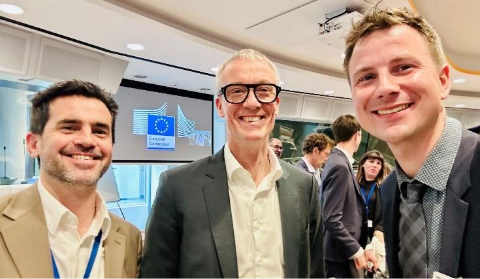
Conversation between Koen Doens, Director General DG INTPA (centre), Sergio Oliete-Josa, Head of Unit Sustainable Transport and Urban Development (left) and EIC Senior Policy Advisor Lionel Clesly at Plenary Meeting of the Global Gateway on 15 May 2025 in Brussels.
EIC was also invited to participate in the 2nd High-Level Conference on Enhanced Coordination of External Financial Tools, co-organised by the European Commission and the Danish EU Council Presidency on 1st October 2025. From the conclusions of this conference, it appears that Europe is eventually tackling its long-standing ‘silo mentality’. There is now a momentum for strategies that have been advocated by EIC for a decade, such as the definition of an EU ‘Whole-of-Government Approach’ through a closer collaboration between Team Europe members and EU export credit agencies (ECAs).

Opening Panel during 2nd High-Level Conference on Enhanced Coordination of External Financial Tools on 01st October 2025 in Brussels.
2. EIC/EFCA Toolkit on Sustainable Procurement
Following the launch of the EIC-EFCA Toolkit on Sustainable Infrastructure Procurement in 2023, EIC promotes its recommendations addressed towards the Multilateral Development Banks (MDBs), their Borrowers and individual Implementing Agencies and Contracting Authorities to incorporate quality, technical and sustainability (QTS) criteria in their large civil works tenders and to award these projects to the bidder presenting the most economically advantageous tender. EIC met on 21st March 2025 in Brussels with the World Bank Vice President for Operations Policy & Country Services, Ed Mountfield, to discuss the key changes in the Bank’s Procurement Policy. Acknowledging EIC’s recommendations, the World Bank now requires a 50 percent minimum quality weighting for most internationally competitive procurement. For contracts with an estimated value over US$10 million, early market engagement will be an integrated part of our processes to attract high-calibre bidders.

EIC President, Benoît Chauvin, EIC Board Member Philippe Dessoy, EIC Director Frank Kehlenbach meet with World Bank Vice President for Operations Policy & Country Services, Ed Mountfield (2nd from left) in Brussels
3. Collaborative Delivery Models (CDM)
During the year 2025, the EIC Working Group on ‘Collaborative Delivery Models’ met various times to finalise its drafting work on the corresponding EIC Position. In February 2025, a joint delegation of EIC and the European Federation of Engineering Consultancy Associations (EFCA) familiarised the Procurement Team of the European Investment Bank (EIB) in Luxemburg with the ‘10 EIC Golden Rules’ on Collaborative Delivery Models. Members of the EIC CDM Working Group shared their practical experiences on the advantages of Collaborative Delivery Models over the traditional delivery model, especially but not only in case of complex projects. EIB, EIC and EFCA agreed to deepen the dialogue on this subject and to involve other interested ‘Team Europe’ financiers as well as the European Commission which has an important role in building local procurement capacity through EU grant financing.

Meeting in Luxemburg between the EIB Procurement Team, led by EIB’s Head of Procurement, Alaleh Motamedi (centre first row) and EIC delegation led by President Gustavo Martínez with further Members of the EIC CDM Working Group: Ingrid Pieters (van Oord), Philippe Dessoy (Besix), Joakim Larkio (YIT Group), Luis Martí (Acciona), Jaap de Koning (Witteveen+Bos) and EIC Director Frank Kehlenbach.
In May 2025, EIC President Gustavo Martínez familiarised the Heads of Procurement of the World Bank and of the Inter-American Development Bank with the EIC concept paper on Collaborative Delivery Models in the context of the CICA mission to Washington D.C. At least for the Banks’ most complex and highest-volume infrastructure projects, tenders inviting Early Contractor Involvement would allow European international contractors to reconsider their participation in tenders and thus bring their expertise and to MDB-financed civil works projects.
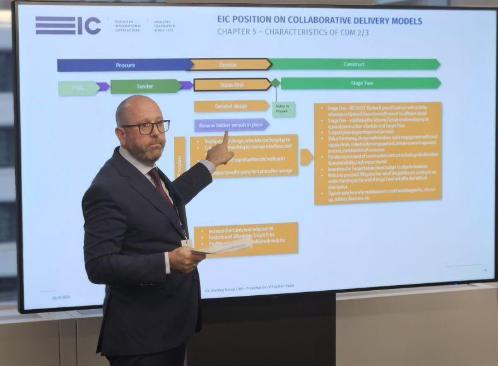
EIC President Gustavo Martínez outlining the EIC Position on Collaborative Delivery Models to the World Bank Chief Procurement Officer, Hiba Tahboub, and her team as well as to the Procurement Department of the Inter-American Development Bank in Washington.
4. FIDIC Standard Forms of Contract Conditions
EIC participated with three speakers in the FIDIC 2024 International Contract Users’ Conference in London which brought together global stakeholders to exchange experience on recent FIDIC contract practice. In April 2025, the EIC Working Group ‘Contract Conditions’ undertook a ‘Friendly Review’ of the FIDIC Draft Form for a Collaborative Contract.

EIC Working Group’s Chair Mathias Fabich during the Official FIDIC International Contract Users Conference on 03rd December 2024 in London.
During a Meeting with the FIDIC President in the context of the CICA mission to the World Bank at the end of May 2025, EIC President Gustavo Martínez welcomed the development of FIDIC’s Carbon Management Guidance. EIC pointed out, however, that it is currently not possible to report all carbon emissions in construction contracts and, therefore, a Carbon Emissions Damages regime in FIDIC Contracts would be counterproductive. With a view to the upcoming FIDIC Collaborative Form of Contract, EIC expressed its expectation that the FIDIC form will embrace the tried and tested contractual tools that help to facilitate collaboration on site, such as Early Contractor Involvement, progressive design and budget development, two-stage contracting with an exit clause as well as pain-gain share in the construction phase.

EIC President Gustavo Martínez met on 31st May 2025 in Washington DC with FIDIC President Catherine Karakatsanis, FIDIC’s General Counsel & Manager, Daduna Kokhreidze, and FIDIC Board Member Manish Kothari (from left to right).
5. Carbon Emission Study
Following the launch of a Manifesto on Achieving Carbon and Resource Neutrality in the European construction sector, published in December 2023, EIC teamed up with FIEC and the European Dredging Association (EuDA) in April 2025 to launch a tender for a comparative study on CO2 emission methodologies applied in public tenders in Europe. The objective of such study is to inform EU Institutions, EU Member States and Multilateral Development Banks about existing methodologies to quantify and calculate CO2 emissions in public tenders in Europe and to make bidders’ capacity to reduce such emissions an award criterion. To achieve this goal, the requested Comparative Study shall map the different methodologies used within Europe and identify best practices as well as specific recommendations for helping public authorities to develop the most adequate methodology to measure and evaluate CO2e emission reductions in public works tenders.

Towards Climate-Smart Procurement: EIC, FIEC and EuDA launched a tender for a Comparative Study on CO₂ Emission Methodologies in European Public Works Tenders.
6. Ukraine Reconstruction
EIC followed FIEC’s invitation to co-organise together with the Italian FIEC-EIC member, ANCE, and with the Confederation of Builders of Ukraine, an official side event on ‘The Green Reconstruction of Ukraine’ during the Ukraine Recovery Conference 2025 (URC2025), hosted by Italy in Rome on 10–11th July 2025. The reconstruction conference in Rome brought together over 3,000 participants to discuss the current state of reconstruction in Ukraine. Key messages included President Zelenskyy’s call for ‘true partners’ in rebuilding Ukraine and Donald Tusk’s hope for peace by the time of the next URC in Warsaw. EIC’s Italian associated member company, MERMEC, reaffirmed in a panel discussion the readiness of European international contractors to support Ukraine’s sustainable reconstruction in line with EU standards and the FIEC-EIC-CICA recommendations for the reconstruction of Ukraine.

EIC Director, Frank Kehlenbach, at the 4th edition of the Ukraine Recovery Conference (URC) on 10-11 July 2025 in Rome
III. EIC Workshops

European international contractors contribute to the discussions at the EIC Autumn Conference in Copenhagen, October 2024.
The EIC Workshop on 4th October 2024, held during EIC Autumn Conference in Copenhagen, attracted more than 80 delegates for a discussion on how Collaborative Delivery Models (CDM) can facilitate large and complex construction projects to ensure that these are on time, in budget and with the envisioned benefits. Concrete case studies with first-hand experience of implementing CDMs, as well the policy, legal and consulting framework were discussed.
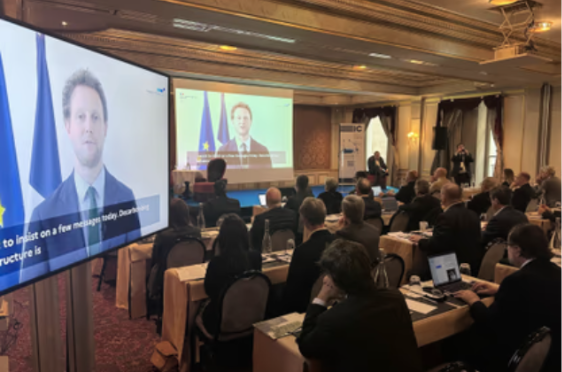
Video Message by Clément Beaune, High Commissioner for Planning; Former Minister of Transport and European Affairs addressing the EIC Workshop.
The EIC Workshop on 25th April 2025, held during the EIC Spring Conference in Bordeaux, attracted more than 100 delegates for a vivid discussion around Decarbonisation of Infrastructure Construction (From Concept to Reality). The Workshop explored the policy and industry aspects of decarbonisation in infrastructure construction, as developed and implemented by the key stakeholders, i.e. regulators, financiers, contracting authorities, contractors and suppliers.
IV. Stay in contact with EIC
To learn more about our activities, conferences and members, please visit our website and follow our posts on LinkedIn.